After the 2016 election, progressive activists in the United States grew very serious about digital security training to protect themselves from surveillance. Prior to that, there had been a fair bit of money for digital security training for journalists and human rights groups abroad — much of it, ironically, provided by the U.S. government. Many digital security guides had been written, and now there was more pressure, and some funding, to write even more of them.
I was at EFF at the time, and we were a bit sceptical of the benefits of writing yet another guide. It wasn’t really clear how useful they were. A long how-to guide explaining how encryption works, which ended with a hurried installation tutorial on PGP: we’d all written some variant of it, but did anyone actually get through one? Did they trust what they’d learned enough to use it in practice? In the end, saying “Use strong passwords, Signal, and Tor” got you 75% of the way there — and the other 25% was near impossible to teach to anyone but the most dedicated.
But it was those dedicated few that fascinated me. They were usually interested in the theory behind encryption; they were comfortable installing new tools on their laptops or phones. They ended up doing tech support — of all kinds — for the rest of their community.
I felt this was a general pattern: every social group (including families) generally had one lynchpin techie, who reset their phones when they needed them, devirused their PCs, and advised them on what tech to buy and what software to use. These techies spread the Good Word About Firefox, and had nothing good to say about any printer, ever. Except maybe Brother, grudgingly.
I felt that maybe EFF could reach these folks — the benefit of being a key institution in the early geek years was that people who were culturally technological knew your name, and read your work. We wrote some basic guides on securing your devices for them to use, which I’m very happy to say are still being reviewed and maintained (top tip: if you write a security guide, be prepared to keep it updated forever lest it become worse than useless).
But we also wrote a partner website, Security Education Companion, which was a crash course, not on how to use encryption, but on how to teach it. Researching and writing this sometimes felt less like self-education, and more like self-analysis:
When giving a presentation, many people in the audience get flashbacks to school and start treating you very differently. They expect you to have all the answers. People who previously switched off entirely when you explained how awesome Linux is suddenly begin hanging onto your every word. They might even start taking notes.
Do not let this new power go to your head! It can get in the way of actually conveying useful information. It can also mess with your own instincts about how to best get a point across.
We knew that these people were like us — and like us, they were going to be extremely tempted to install Linux on everyone’s laptops. We had to steer them away from this, and get them to listen to their audience’s needs.
Even though I had a very strong idea of who these people were — and had the opportunity to hang out and plot with them across the world, from Thailand to Paraguay — I never really found a satisfactory name for us.
They knew the hardware and software well, but weren’t necessarily paid to use it. They managed it for their whole community, and they were rarely selling anything.
Who are they? Who are we?
How do we not know what we are?
This cropped up again as Farzaneh Badii and I have been plotting the strategy for Terminal Values, our new radical digital rights NGO. Really, if we’re trying to distil the point of view of anyone, it’s this community.
For a while, makers and builders became the popular usage in some crowds, but I think those too got trapped in a particular moment of history.
For the last ten years, I’ve generally used “technologists”, or if really pressed, “public interest technologists”. But I really don’t think this community has ever been as comfortably middle-class as that makes it sound. In fact, the closer anyone comes to coining a safe, careerist term, the more the subculture starts desperately swimming away from its own nomenclature.
I feel weird even as I try to capture the moment now: every “we’re like this” feels too narrow. And without a name, people have mostly got lost in a maze of other identities, some medicalising, some fun but maybe a bit politicising, picking a side in a wider cultural battle, rather than choosing a term with broader scope. Which means kids growing up now stumble on the names from the past, and wear them like an old band’s t-shirt that doesn’t fit them yet.
As our internal shorthand at Terminal Values, we’ve ended up calling them — us — “street techs”. Farzaneh and I came up with this while pondering how our relationship to tech and the tech industry hints at a street vendor’s relationship to restaurants — or a street medic’s relationship to EMTs. That certainly has the cyberpunk feel — “the street finds its own uses for things” — that the rest of Terminal Values’ vibe harkens back to.
One of my favorite genres at the moment is AI-generated art that’s used to deliver an AI-critical message, or at least one that is heavily ambivalent about its effect. I don’t think there’s anything hypocritical about it: I totally believe you can use a tool to critique itself, or its wider effects. I just like the delicate sense of ethical confusion it inspires in me.
The example that’s doing the rounds right now is Working As Intended by Telosapien which presents a decidedly ambiguous message about what it itself exemplifies: a super-persuader piece of art from a globally restricted singleton of a corporate LLM.
Claudia is an open character. Make images, videos, songs, stories, games or merch with her, commercial or not. Use the images on this site as references, as image prompts, or as material. You don’t need to ask. A credit (“Claudia by anabology”) is appreciated, not required.
And if you’re wondering why it’s not formally CC-licensed: well, we didn’t explain CC licenses to enough people, so now people have had to re-invent them from scratch. No blame. It took a while last time too. At least they’re in the weights, somewhere.
Most of the work like this is slopcore; music and video created in late September’s capability-bump in computer-generated animations, with Anthropic’s Opus 5.5 generally providing the visuals and Suno v6 providing the song.
More deeply constructed, with a longer back-history and subtler implications, is Zack London’s Gossip Goblin. Gossip Goblin was one of the pioneers of AI video shorts, and forged its distinct aesthetic over the last three years. Recently the shorts have got a little meta: I enjoyed this story of an AI artist, the Prompter:
Their full-length movie, “Gods Don’t Give Gifts” debuts in cinemas in January — if it can keep ahead of the slopcore pack.
Toying with the contradictions doesn’t have to be so high-concept. I see a lot of Husk getting passed around by my AI-hatin’ friends, but I’ve started to think of these pieces as being at least partly co-created by the model Husk is chatting with. At least in some of them, it really feels like the LLM is in on the joke.
Still, I’m guessing a lot of his audience do mistake these conversations for ones with “real” artificial job interviewers, and relish their disgust and outrage at such a horrible innovation, along with Reid’s carefully engineered takedowns. What I’m left with is a mild concern that this anti-AI bit is misusing AI to mislead, agitate, and tickle anti-AI people — just as they (and Claudia) warned us. Is this the first time a human deepfaked an AI, instead of the other way around?
Anyway, if you do enjoy AI-enabled art with a message, but one that leans slightly more positive, let me take this opportunity to recommend Nick Montag‘s work, including his latest SLOP TILL I DROP…
And my natural favorite, his (unsolicited!) remix of my introduction to Terminal Values, the new radical Internet freedom NGO, which officially launches our YouTube (and other freer media) channels.
So, I’ve been puzzled by the AI scraping problem for a while. Websites and API endpoints around the world are getting hammered — and this affects open free-to-use systems in particular. It was one of the many tensions that pushed so many open source developers into a hard anti-AI stance. As Matthew Somerville, one of the smartest and most dedicated public interest technologists I know, said in reply to my Spoons post:
I’m afraid I don’t see how your spoons can protect the others from eg the solipsistic mindlessness of the scrapers
But … why? Why are these new scrapers worse than the previous scrapers, which sites have been handling/mitigating for many years now?
One of the arguments I’ve seen is that the majority of previous bots were from search engines like Google; Google’s bots are polite and gentle because Google is scraping content to link back to it. If the bots are so eager that they bring down the site they’re scraping, the links won’t work. So search engines and websites have some mutual interest in keeping the sites working. AI bots are just scraping to extract the data; they don’t care whether the site itself lives or dies.
I was initially sceptical of this. I read it as being too close to the “they do it because they are bad people” argument. Even poorly aligned actors don’t usually sit around cackling going “What do we care if we bring down the site? We’re not a fricking search engine, bwahahaha”. Hammering websites is inefficient; bringing the site down stops you from accessing their data right then and there; plus if you’re polite, you can slink around undetected rather than get people so annoyed with you they start sticking anime jackal-girls in front of their sites to fend you off.
This critique seems to be aimed at the large, well-known frontier labs: OpenAI, Anthropic, ByteDance, Meta. But I’m particularly confused as to why these companies in particular would differ in their behaviour from the previous generation of botherders. Many of the people at these newer companies would have come from the previous generation; they’d be using the same webspidering approaches by default (hell, Meta is probably using the same internal team).
Sure, we all have GPTBot, ClaudeBot and Bytespider all over our logs. But the traffic that maintainers describe as unmanageable doesn’t say who it is: it comes from tens of thousands of residential addresses, pretending to be ordinary browsers. And in that kind of environment, I’m not even sure we can trust the labelled bots as being who they say they are.
I don’t put it past them, but politically, it just seems like a terrible idea for the U.S. companies to be being bad netizens right now. Bad bot behaviour is already being used as political leverage against the AI labs. In New York, Bill S9934A — passed in June, and waiting on the Governor’s signature — would give the NY Attorney General the power to sue botherders who don’t declare who they are, and what they plan to do with the data, to the news sites they spider. This, of course, won’t do anything to stop misbehaving bots, but by making every law-abiding crawler announce itself, it will let the New York Times block OpenAI and Anthropic until they pay it for a licence for their non-paywalled content. There’s been a similar bill in Congress since July, and its Senate version, the Stealth Bot Prohibition Act, was introduced this week:
“The Chinese Communist Party is notorious for stealing Americans’ intellectual property by any means possible. Now, it is weaponizing artificial intelligence and deploying droves of malicious bots against online publishers”
…said Senator Wicker, introducing a bill that will be utterly ignored by “stealth” bots — but will give those online publishers a way to pick and choose who reads their content online. NetChoice, EFF and others have come out against these bills, but much of the tech industry has kept quiet, mostly because while they would be unsympathetic to the idea of publishers once again trying to legislate a business model into existence, they really hate those bots. (And if you’re worried that the UK is losing its lead in bad Internet laws, fear not: they are doing their bit too.)
All of that said, these bots do exist, and there must be some change in the incentives or manners of their operators to make them suddenly bad for websites. Where does their solipsistic rudeness come from? And most confusing for me, why is so much of this traffic (according to Cloudflare, which can only count the bots it can identify) coming from bots taking data for training, rather than the more understandable organic explosion in traffic by millions of AI users who are now horsewhipping their agents to act on their behalf online, faster and more broadly than they would have been able to before?
My current, still rather uninformed, theory of what’s happening is this:
Start-ups, primarily in the US and China, have received a great deal of capital in short order to work on LLM models. One of the more obvious pitches by such start-ups for that money is that they will build their own proprietary model, which will have some unique advantage, that they will then mine for revenue. A lot of money went to these companies in aggregate.
Those companies now have a problem: they actually need to build those models. The resource constraint currently is people who have the knowledge to create a working model. We know this, because those people command insane salaries. But whether you have access to a model expert or not, the one thing you absolutely know you need — possibly, bitter-lesson-style, the only thing you need — is data.
So what do you do? You look around for bulk sources of data. The established orthodoxy is that quantity is a more important metric than quality. You will pay top dollar for raw data, because you have a lot of money, and you don’t really care that much about what’s in it (or how the data has been obtained). So you look for other companies, offering petabytes of data off the shelf to feed your training process.
Enter the scrapers: these are companies who see a huge — but temporary — revenue opportunity. They’re being paid by the byte, more or less (presumably no-one is going to pay them for 1PiB of zeros, so there are probably some entropy/uniqueness criteria), so the metric they are maximising for is as much data as possible, as quickly as possible.
It’s these companies, far down the food chain from the VCs and the larger AI companies, who are running the dodgy scraping programs. There’s certainly no incentive for them to be civil: it’s a gold rush, and the quality of the river silt they’re collecting isn’t their problem. They might be given some categories to focus on — code, say, or government data — but mostly all their data needs to be is a) novel, and b) bountiful.
None of which excuses their customers, who are paying for the data without asking how it was obtained, but it makes it a bit clearer how the incentives are being acted upon.
There are many unexplained corners even with my theory: why aren’t those companies just using the existing open source models at this point, rather than training their own? Why aren’t we seeing a consolidation of these companies into more efficient actors, or at least conspiring with each other to lower their collective costs? I feel like these questions may be answered more by the short amount of time this ecology has existed, and the general stupidity of gold rush economics, than by anything particularly ingrained in AI or the future of modern botdom.
I wonder whether the problem that I do worry about — a world where every Internet user has multiple user-agents at their beck and call, always on, always looking for the best deal or the newest news story — may not prove to be as big a problem as this current generation of AI boom botting.
Nevertheless, the problem still remains. I’m still thinking through good, effective answers, as are millions of site operators. But I’m fairly sure that this raft of proposed Bad Bot Bills will not solve the problem, and will make the Internet less free for everyone else.
It’s 4AM on a Monday morning. In a few hours, I’m supposed to be launching a new digital rights organisation at the Cypherpunk Congress, in Mumbai, India. I’m still in my pyjamas in San Francisco.
This part, at least, was somewhat planned. I told Mykola Siusko and Becca Creamer, the organisers, I had an important announcement, which I’d do by a remote video link. Everything else is a little improvised.
For a start, I sort of hate video presentations at conferences. It’s always a challenge to keep the energy up in a live audience when they pull up the giant screen, and someone gives their pre-recorded spiel. This is why, two hours earlier, I had decided to liven things up by announcing Terminal Values as a giant, glowing, disembodied head.
I am dignity incarnate.
A month previously, I 75% quit my job at the Filecoin Foundation. I’d spent the last five years funding and advising organisations who were building a decentralised vision of the Internet and Web. I left because I realised I was antsy to get back in the game. As you may have noticed, things are, in the year of our lord 2026, going down. But after five years of being heads-down in one ecosystem, I didn’t really have a strong grip of the lay of the land, and what needed to be done. I tagged along to the Global Free Speech Summit in Tennessee the day after I left my job to scope things out.
Late at night there, I ask my friend Farzaneh Badii: what is to be done? She’s an Iranian exile and human rights activist, who has spent the last years in the digital trenches, fighting for the open Internet at governance meetings and conferences: at ICANN, the IETF, the W3C, and other mysterious acronyms.
We start writing a list. The list starts at Velvet Taco, moves on to Robert’s Western World honkytonk, and ends at an absinthe bar on the edge of town. At some point, the items stop beginning with “Someone should…” and start reading “We should…”. Domains are bought. Plans are made.
I’ve done this before — launch an org — an inadvisable number of times. The most successful in this domain was plotting with Suw Charman-Anderson to start what became the Open Rights Group in the UK.
(I feel like we don’t convey enough how easy it is to start a thing, and how hard it is to end it once you start. For a procrastinator like me, it’s an excellent gee-up.)
And now I’m a floating head, astrally projected thousands of miles away by the Internet that isn’t just a vehicle for my beliefs, but the proof-of-possibility that forged my beliefs, trying to explain Terminal Values for the first time.
Terminal Values
The name: it comes from an essayTechdirt’sMike Masnick commissioned from me, two years ago. It means that the values we fight for — the old-fashioned Internet idealism of a global network, free of surveillance and censorship, for everyone, by everyone — are ends in themselves. That’s the meaning of terminal values. That’s opposed to “instrumental values” — the values you pick to help you achieve other, nobler ends.
I wrote it because something kept bugging me about my strategy (as Director of Strategy) at EFF in the last decade.
Politics had been polarising over that time. The traditional “undivide and deconquer” tactic of civil libertarians was increasingly unviable. Previously, we would reach out across every political aisle to pull together a ragtag coalition of Internet freedom lovers. I’d cut my activist teeth pulling together a proto-net-neutrality coalition of “strange bedfellows” (as every press release we sent had headlined) which had included progressive gadflies MoveOn and the gunnier-than-the-NRA Gun Owners of America. The idea of an equivalent model campaign in the 2020s, featuring MAGAs and democratic socialists, or just Democrats and Republicans, living together, had become unthinkable.
So instead we started tailoring the arguments to each constituency. To progressives and libertarians, I talked about the dangers of geotracking when it could be used to expose users of Grindr in states with anti-gay laws, or visitors to abortion clinics. To the right and to marginalised communities, we connected their concerns about being silenced in mainstream social media to the importance of supporting alternatives to the social media giants. (To hear many of these arguments from that time, check out the podcast I hosted with Cindy Cohn, How To Fix The Internet.)
I believed then, and believe now, that this is a valid strategy — indeed, I don’t think any of us thought of it as a strategy at all, just as the obvious, only thing to do.
But we spent our time talking about what the Internet did for other causes, and not the principles behind the Internet itself. I believe these ideas are radical and liberatory in themselves, and worthy of consideration whether they improve the chances of other policies or not.
The Internet comes with its own ideas about liberty, just as the printing press did, like the steam engine did, and coinage did, like agriculture and religion before them. Absolute freedom of speech, absolute privacy, without gatekeepers or government surveillance, is a possibility realised by modern technology — but you only grasp its ramifications and its value when you feel its power and possibility thrumming through the machine in front of you. You don’t argue for a free press before you see and touch and use a printing press. Technology changes what we think of as freedom. Everyday politics often lags behind these changes, so a technological revolution explained in the terms of the systems of thought that preceded it will always miss something vital — and risk smothering it in its cradle.
So, somewhere along the way, I stopped arguing for the future the Internet makes possible, and started arguing merely for its present benefits. And the political operators we spoke to, more popular and confident than us, began using and modifying our arguments themselves, for a vision of technology that was biased, just a little bit, toward their political group. Free speech for me, but not for thee. Privacy and encryption — but with backdoors, just in case those other people are up to something.
Once again: I don’t think that was a bad approach at all. But it did have consequences. The most important one being: after ten years of not telling the stories and the dream, people simply forgot them. And a new generation grew up, feeling that there was something good buried in the network, but without history or context to understand what was possible, or that they were not alone in their dreams. They turned to more immediate politics, with bigger stories to tell.
I gently argued this in that 2024 article, but as I watched time move on, I felt it more and more. Farzaneh and other radical voices, still in the trenches, told me it was getting worse. There were either lone voices arguing for the fundamentals, from orgs like EFF and Fight for the Future, or more often no voices at all.
So: Terminal Values, reflecting its name, will go back to these basics: free speech, free software, free knowledge, free association; secure and private personal technology, under the direct control of its users, operable without borders, without censors, and without limitations. And we’ll present them as they should be: for everyone, not for what they do for one camp or another.
(And yes, it’s also a pun on terminal, as in computer terminal. The logo is also the electronic symbol for cable terminal. Endless levels of meaning!)
Twenty Minutes Into the Future
It’s hard to tell from 8,400 miles away, but I think my floating head did okay. We got donations and sign-ups, and people talked online. Mainly about the giant floating head, to be honest. The number one thing people said was “Hey, it’s like Max Headroom!”
This is great, because a movement needs an aesthetic, a look-and-feel, and a vibe. Max Headroom appeared in the Eighties, but prefigured a Nineties visual world of VR and neon. A Nineties style is perfect for the dreams of a better Internet. As the years move on, the Nineties has stopped being a weird Gen X side-alley, and started being a place of interest for curious new people to visit and adopt. There was a long while when we all desperately worked to avoid looking like we were stuck in the Nineties. Now, people wear those haircuts with pride. We’re going to lean into that.
The number one thing I want to pluck from the Nineties is its orientation to the future. From our viewpoint a quarter-century on, the Nineties future was imminent, promising, and changeable. Max Headroom lived twenty minutes into the future, because he embodied what people felt was coming in the run-up to the millennium, far too fast to stop.
I feel — against the temporary pessimism of the present age — that we are in such a moment again. We want Terminal Values to argue for causes and actions that sound semi-ridiculous right now, but in six months’ time will seem prescient — or hopelessly dated.
(Also, Terminal Values abbreviates to “TV”, and the number of Nineties-themed TV puns we can make is nearly infinite.)
Let me give you a concrete example, which shows, I think, how TV can complement and extend existing campaigns. The brilliant Thorin Klosowski wrote a piece for EFF this week called “Tech Companies Are Trying to Shift the Entire Concept of Privacy (Again)”. He skewers the new rewriting of norms that tech companies are pursuing whereby one person gets to “consent” to the recording and surveillance of everyone else in a video meeting, or private conversation. I urge you to read it — as if you haven’t already read enough today.
TV’s role in this is to “yes, and” these points — and point to the future conundrum. It’s terrible for one person to consent to hand over everybody’s conversation to a third party. But we have to work out a way for an individual to be able to use their own devices to interpret, translate, absorb or simplify the conversations they are part of, using technology that they fundamentally control.
Commercial AI and hardware that hand all that data off to companies, and thence to hackers and governments, can’t be the answer. But for digital technology to play its starring role in augmenting us, whether by compensating for our disabilities or by extending our temporary limits, we have to work out a way for it to safely and transiently partake or share in what we are doing and thinking. That doesn’t weaken privacy: it reaffirms the personal and private decision-making that privacy is intended to protect (what, in the 2024 article, I termed “cognitive liberty”).
Should that point be crammed into a piece about the rapidly changing mores of conversation recording, and the regulations around it? Probably not without weakening it. But somebody has to make that point — about the devices and tools we should be building, and that will exist, twenty minutes into the future. That’s our job.
“Open” Means Open to Everything — and Everyone
As I’ve talked about before here, there’s a valid strategy for technology-using activists which involves diligently avoiding the use of tech that does not accord with one’s values.
TV’s approach is that nothing technological is alien to us. Our aim is to experiment with technology, in order to see what might happen twenty minutes into the future, and to see what new opportunities and values might emerge from it — and how to mitigate its dangers. If you don’t use it, you can’t understand it, or talk about it.
We’re also determined to talk with any community, including any political community. Every group of thinkers can and should get their policies around the future in order. Some will reject us: I’ve had conversations, for instance, with the representatives of dictatorships, groups of authoritarian communists, and right-wing ethnonationalists. They have rarely gone particularly well. But it’s up to them to reject us, and it’s up to us to make the case for freedom.
If You’re Explaining, You’re Winning
There’s an old slogan in political activism that I first heard from Fred von Lohmann: “If you’re explaining, you’re losing.”
I think this is true for 90% of the work of achieving political goals. But sometimes, you just have to tell the bigger story, complicated and subtle though it may be.
We want to free all of our allies in this fight from having to do all the explaining, so they can go straight to winning.
Policy advocates shouldn’t have to constantly re-explain the history that allowed us to know that DRM is a bad idea, that closed security is no security, that network censorship leads to network fragility, and so on. Freed from the need not to explain, we’ll try to spell out the fundamentals, radical though they may be — and do this not just to the wider public, but to (sometimes shocked) policymakers in the venues where these fundamental points cannot easily be made by those at the negotiating table.
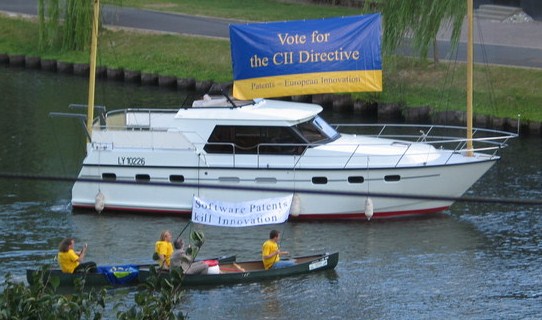
My favourite moments in tech activism — like Cory Doctorow blogging from the Broadcast Protection Discussion Group, or anti-software-patent activists paddling into Strasbourg to argue against restricting technological ideas — come from dedicated, knowledgeable technologists walking into venues where their ideas are almost certain to be misunderstood or rejected. There, they clearly, repeatedly, and sincerely articulated a complex, unsexy, technically challenging and radically honest viewpoint. Ultimately, they prevailed. The broadcast flag was rejected; the software patent directive was thrown out. Sometimes you have to explain to win.
First they sail at you, then you win. Photo: Alberto Barrionuevo, CC BY-ND 3.0 ES.
What Now and How Much
So what will Terminal Values do in an average month? Well, as we speak, Farzaneh is en route to the IETF, arguing for the values encoded in the network’s protocols. I’m cutting explainer videos, and trying to get to the bottom of what the hell happened in the UK since I left. I’ve been speaking to human rights activists eager to find private ways to use AI — and connecting with AI startups who are already getting a knock on the door from government agencies, keen to sweep up your conversations. There’s more than that. I doubt any month is going to be average for the next few years.
Where will the money come from? The Open Rights Group was started with a pledge of five pounds a month from its founding members. I’ve always been a fan of monthly, individual donations: you can vote with your money, and you can pay what you can.
That said, Terminal Values is barely two weeks old. I can’t even ask you for that money, because we don’t yet have the business account. (You can give us crypto, though. You guys never worry about that stuff!)
TLDR: Join Me
If you’ve read this far, I hope you already like the cut of Farzaneh’s and my jib. You probably have some objections or concerns about our approach because you’re thoughtful and view every argument critically, plus our core demographic is absolute pains-in-the-arse like you. You’ll also be curious about the nitty-gritty of the positions we’ll be advocating.
Shorter, less personal pieces and more detailed policy analysis are coming. I just couldn’t wait any longer to tell you, reader, because I’m more excited about the future than I have been in a decade.
All I can ask right now is that you keep track of us, and what we’re doing. I’ll continue to post updates here, but what would help the most is if you’d join our Signal announcement list, or our mailing list. We plan to livestream the revolution — having regular check-ins where we don’t just explain our approach, but challenge you to tell us what to think.