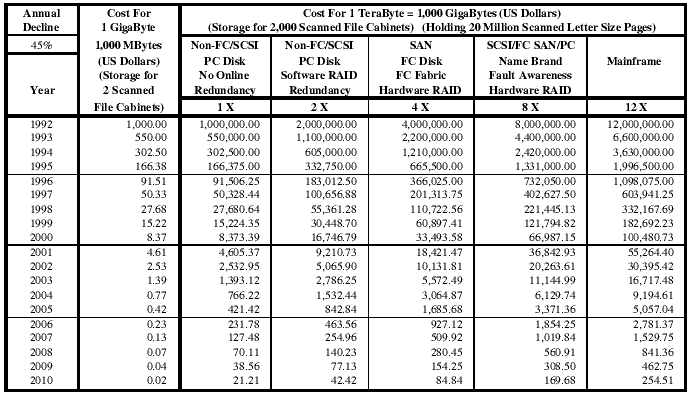
A friend wrote asking me if a petabyte would be an affordable amount of disk storage in five years time. Blowed if I know, but in scrabbling to answer, I did find this great projection of the next twenty years of magnetic storage. It contains this graph which is based on IBM estimates of future storage capacity and price. (which I couldn’t be bothered to convert into HTML – hey, but maybe you will and sent the text to me. Updated 2004-07-11: For my birthday, Adrian Furby sent me this HTMLised. Thanks, Adrian!)
| Annual Decline |
Cost for 1 GigaByte
1,000 MBytes
(US Dollars)
(Storage for 2 Scanned File Cabinets) |
Cost For 1 TeraByte = 1,000 Gigabytes (US Dollars)
(Storage for 2,000 Scanned File Cabinets) (Holding 20 Million Scanned Letter Pages) |
| 45% |
Non-FC/SCSI
PC Disk
No Online Redundancy |
Non-FC/SCSI
PC Disk
Software RAID Redundancy |
SAN
FC Disk
FC Fabric Hardware Raid |
SCSI/FC SAN/PC
Name Brand
Fault Awareness Hardware Raid |
Mainframe |
| Year |
1 X |
2 X |
4 X |
8 X |
12 X |
1992
1993
1994
1995 |
1,000.00
550.00
302.50
166.80 |
1,000,000.00
550,000.00
302,500.00
166,375.00 |
2,000,000.00
1,100,000.00
605,000.00
332,750.00 |
4,000,000.00
2,200,000.00
1,210,000.00
665,500.00 |
8,000,000.00
4,400,000.00
2,420,000.00
1,331,000.00 |
12,000,000.00
6,600,000.00
3,630,000.00
1,996,500.00 |
1996
1997
1998
1999
2000 |
91.51
50.33
27.68
15.22
8.37 |
91,506.25
50,328.44
27,680.64
15,224.35
8,373.39 |
183,012.50
100,656.88
55,361.28
30,448.70
16,746.79 |
366,025.00
201,313.75
110,722.56
60,897.41
33,493.58 |
732,050.00
402,627.50
221,445.13
121,794.82
66,987.15 |
1,098,075.00
603,941.25
332,167.69
182,692.23
100,480.73 |
2001
2002
2003
2004
2005 |
4.61
2.53
1.39
0.77
0.42 |
4,605.37
2,532.95
1,393.12
766.22
421.42 |
9,210.73
5,065.90
2,786.25
1,532.44
842.84 |
18,421.47
10,131.81
5,572.49
3,064.87
1,685.68 |
36,842.93
20,263.61
11,144.99
6,129.74
3,371.36 |
55,264.40
30,395.42
16,717.48
9,194.61
5,057.014 |
2006
2007
2008
2009
2010 |
0.23
0.13
0.07
0.04
0.02 |
231.78
127.48
70.11
38.56
21.21 |
463.56
254.96
140.23
77.13
42.42 |
927.12
509.92
280.45
154.25
84.84 |
1,854.25
1,019.84
560.91
308.50
169.68 |
2,781.37
1,529.75
841.36
462.75
254.51 |
As you can see, a petabyte will still cost about $70,000 in 2008. Consolation prize: a terabyte will sell for $70. Better start saving those files now!
Comments Off on waiting for the exabyte drive
According to a cursory IMDB search, Jason Schultz has discovered that 93% of the movies released from 1927-1946 are unavailable (it’d be interesting to include current TV showings in this – what was that site that let you grep through US TV listings for keywords?). As an interesting aside, the IMDB has 36,386 titles for that period. The copyright office says there are 37,144 – which means that the IMDB, a largely amateur effort, has snagged 98% of the titles. All goes to show that Kevin Kelly’s assertion that enthusiasts might be better at preserving film history than paid copyright holders might turn out to be true. (Off of the rc3.org)
Comments Off on so much for the protection of copyright
A new and better patch for the old linux-wlan on the 2.4 kernel; an addition to How To Wash Dishes that was meant to be added in March (sorry Dave.)
Comments Off on signs i’m getting through my mail backlog
A lesson in game design, hosted on IRC.
Comments Off on omfg!!th1s tutor1al r0xxxors!1!!
How many inhabitants does Sunnydale need to support its apparently limitless supply of vampires? Brian Thomas, PhD candidate in ecology at Stanford, investigates. (From More Like This)
Comments Off on the vampecology of sunnydale
It’s December, so it must be time for the Perl Advent Calendar: one CPAN module explained (with brief tutorial) every day. Day one taught me about finding URLs in text, day two explained how to write to files in place with automatic data recovery if it all goes wrong, and day three showed me a all-Perl Perl-and-C mini-SQL database in less than 300KB.
Comments Off on perl advent calendar
I use public transport a lot – even in Silicon Valley, where it sucketh like the Black Hole of Calcutta. To do so in such bus and train deadzone requires exactly the kind of juggling of schedules and careful dead-reckoning navigation that I am utterly lame at.
This is why I depend on online journey planners (like these versions for San Francisco and London). I also walk around quite a bit, trying hard not to get lost. A little pocket GPS and an online street address to latitude/longitude converter have revolutionised my wanderings, around and apart from public transport trips. I hardly ever get lost anymore, and I rarely underestimate how long it will take to get somewhere.
There’s just a whole stack of destinations that this tech has let me see are perfectly reachable without a car, even in California.
Now add into the mix services like NextBus, which monitors and shares info on the realtime position of all the buses in San Francisco. Wrap it all into some portable device (or wireless service), that lets me provide an street address, and plots a route and ETA on the fly.
I feel confident with more realtime info, and realtime positioning, a lot more folk would be tempted by public transport, or indeed walking, than now.
That it takes slightly longer to get places doesn’t bother me – I get a lot more done on a bus or train than I do even as a passenger in a car. The cost is a pain in the Valley ($4.00 for a day pass), but in most decently-run trans areas that burden is less acute.
No, the largest hurdle public transport has to overcome, I think, is the feeling of powerlessness and unpredictability it induces in most people. I think you can go a long way to reducing that – without requiring any heavy initial investments in public transport itself, by harnassing this new tech. It’ll never be for anyone – but it’s certainly increased my usage, and appreciation of, even one of the flimsiest public trans system in the world.
Comments Off on software in the public transport interest
So I googled for a biography of Winston Churchill, and this was the second hit. It’s a fine potted history, but ends on an odd note:
…During all of his life he had served no less than six British monarchs: Queen Victoria, Edward VII, George IV, Edward VIII, George VI and Elisabeth II.
He also possessed a large collection of toy soldiers. However in his book ‘My Early Life’ he does not mention which make of soldiers he collected. They were probably all made between 1880 and 1900 and therefore some time before Lineol and Hausser figures became available. As a collector he might be the only one of whom also a personality figure was produced.
… and then I realise. This is the biography of Winston Churchill, as it affects the world of toy soldiers. Did that make it any less useful, though?
Comments Off on source for the goose
SpinSanity is exactly the sort of site that I don’t visit as much as I’d like, but would read every day in a RSS reader like NetNewsWire. And now they’ve added a RSS feed, I can. Hooray!
Except I’m not using OS X much these days, so I don’t have an RSS reader. Time to play around with Straw.
Comments Off on spinsanity gets an rss feed
Over seven hundred slides from Peter Gutman’s Godzilla Crypto Tutorial. I imagine aliens flipping through this in about thirty seconds to absorb all current knowledge regarding the uses and abuses of crypto. Not particularly mathematically heavy-weight, but pretty techie in parts. The seventy-one slide guide to crypto politics is pretty comprehensive (not entirely up to date though). I got this from the enhyper financial crypto digital library mailing list, which occasionally turns up some great resources.
Comments Off on gutmann’s guide to everything crypto